



Vitamin D Levels for Indoor vs. Outdoor Athletes: What the Research Says
We know that vitamin D is extremely important. You probably also know that it’s one of the most common vitamin and mineral deficiencies among Americans.
You may think that if you train outdoors, you may be in the clear on this. But the research tells a more nuanced story. The difference in vitamin D levels between indoor and outdoor athletes is smaller than you’d probably guess. Sorry to deliver the news to all the cyclists and runners.
Let’s look at what the research says, and decide
The largest analysis to date pooled 33 studies and 5,150 athletes. Outdoor athletes averaged 31.4 ng/mL of vitamin D in their blood. Indoor athletes averaged 27.7 ng/mL. Season moved the number about twice as much as training location did.
Three things decide your level more than your sport does: how much midday sun reaches your skin, the time of year, and how far north you live. Here is what the research found, study by study.
Why Training Indoors Means Less Vitamin D
Your skin makes vitamin D when UVB light from the sun reaches it. No UVB, no production.
A gym blocks all of it. Walls do, and so does glass.
That is why researchers started sorting athletes by where they train. You can be fit, well fed, and training twice a day, and still go months with almost no midday sun on your skin. Lifters, basketball players, swimmers, gymnasts, dancers, hockey players, and anyone whose cardio lives on a treadmill or a bike trainer all fit that description.
A 2013 review in Nutrients looked across the athlete studies available at the time and landed on a plain conclusion. Lack of sun exposure was the main risk factor, which put indoor athletes and those who avoid peak daylight hours at the greatest risk of running low, wherever they lived.
What the Studies Found, Sport by Sport
Most groups of athletes that researchers have tested had a large share running low, and the indoor groups usually sat at the high end.
|
Athletes tested |
Trains |
Where |
What the study found |
Study |
|---|---|---|---|---|
|
Dancers, basketball players, and other athletes (98) |
Indoor and outdoor |
Israel, 31.8°N |
80% of indoor athletes were below 30 ng/mL, against 48% of outdoor athletes. Dancers and basketball players: 94%. |
|
|
Elite female gymnasts (18) |
Indoor |
Australia |
83% were low. A third were below 20 ng/mL. |
|
|
College athletes, indoor and outdoor sports (41) |
Both |
Wyoming, 41.3°N |
Below 32 ng/mL: 12% in fall, 63% in winter, 20% in spring. |
|
|
408 elite athletes across 34 sports |
Both |
Spain, 41.4°N |
82% were below 30 ng/mL. |
|
|
555 athletes across 44 disciplines, mostly youth |
Both |
Turkey, about 39°N |
Average fell from 28.1 ng/mL in fall to 16.9 in winter. No significant indoor-outdoor difference. |
|
|
Professional sportsmen |
Both |
Qatar, 25.4°N |
90% were low between April and October. They averaged under 30 minutes of sun a day. |
Hamilton et al., 2010 |
|
20 Premier League soccer players |
Outdoor |
England, 53°N |
Average fell from 41.6 ng/mL in August to 20.4 in December. 65% were below 20 ng/mL in winter. |
|
|
College rugby, football, track, and cross country athletes |
Outdoor |
Washington State, 46.9°N |
25% to 30% were low from fall to winter. |
Storlie et al., 2011 |
|
Distance runners |
Outdoor |
United States |
42% were below 32 ng/mL. 11% were below 20. |
Willis et al., 2012 |
Studies use different cutoffs for "low," usually 20, 30, or 32 ng/mL, so the percentages are not directly comparable from row to row.
What the pooled numbers say
Three research teams have combined the individual studies into review studies.
-
Farrokhyar et al., 2015. 23 studies, 2,313 athletes. 56% were below 32 ng/mL. The risk was higher in winter and spring, at higher latitudes, and in indoor sports.
-
Harju et al., 2022. 33 studies, 3,592 elite athletes. Using the stricter 20 ng/mL cutoff, 30% of adult athletes were below it.
-
Bârsan et al., 2023. 33 studies, 5,150 athletes. Outdoor athletes averaged 31.4 ng/mL and indoor athletes 27.7 ng/mL.
Indoor athletes come out lower in most comparisons, but the gap is modest. In the 2023 analysis, training indoors was linked to a level about 4.4 ng/mL lower once season, latitude, and other factors were accounted for. Winter was linked to a level about 8.6 ng/mL lower.
The same team pointed out that average levels sat well below 32 ng/mL in winter and spring for indoor and outdoor athletes alike.

Outdoor Athletes Are Not Automatically Covered
Training outside helps only if the sun is strong enough and actually reaches your skin. Often it does not.
-
Time of day. Many outdoor athletes train early in the morning or in the evening, outside the midday hours when UVB is available. In the Spanish study above, synchronized swimmers who trained outdoors all day had higher levels than those who trained only in the morning or late evening.
-
Winter sun. The Premier League players in the table train outdoors for a living. Their average level still halved between August and December. Winter sun in many places is just not strong enough to supply optimal vitamin D levels.
-
Coverage. Sleeves, tights, helmets, and pads all cut the amount of skin the sun can reach.
-
Time in the sun. The athletes in Qatar live at a latitude with strong sun most of the year. They averaged less than 30 minutes of it a day.
Season, Latitude, and Skin Tone Matter More Than Time in the Sun
Season. This is the big one. In the Wyoming study, the share of college athletes below 32 ng/mL went from 12% in fall to 63% in winter. Same athletes, same sports, same campus.
Latitude. North of roughly 37 degrees, the winter sun sits too low to produce meaningful vitamin D for several months. We cover that in more detail in our Vitamin D3 + K2 introduction.
Skin tone. Darker skin needs longer sun exposure to produce the same amount of vitamin D, especially in winter.
Your actual schedule. A lifter who walks to the gym at noon may see more useful sun than a runner who is out the door at 5:30 a.m. Count the minutes of midday sun on bare skin in a typical week. For most people training through winter, the answer is close to zero.
What to Do With This
1. Get your number. Low vitamin D has no reliable symptoms. A 25-hydroxyvitamin D blood test, written 25(OH)D, is the only way to know where you stand. The authors of the 2013 review recommended that indoor athletes, and those who avoid peak daylight hours, have their levels checked once a year. The 2023 team went further and suggested testing regardless of training type, at least in winter and spring. Ask your healthcare provider.
2. Look at your plate. The meaningful food sources are a short list: fatty fish, egg yolks, and fortified dairy. Unless you are very intentional about eating lots of these foods, they will not close the gap.
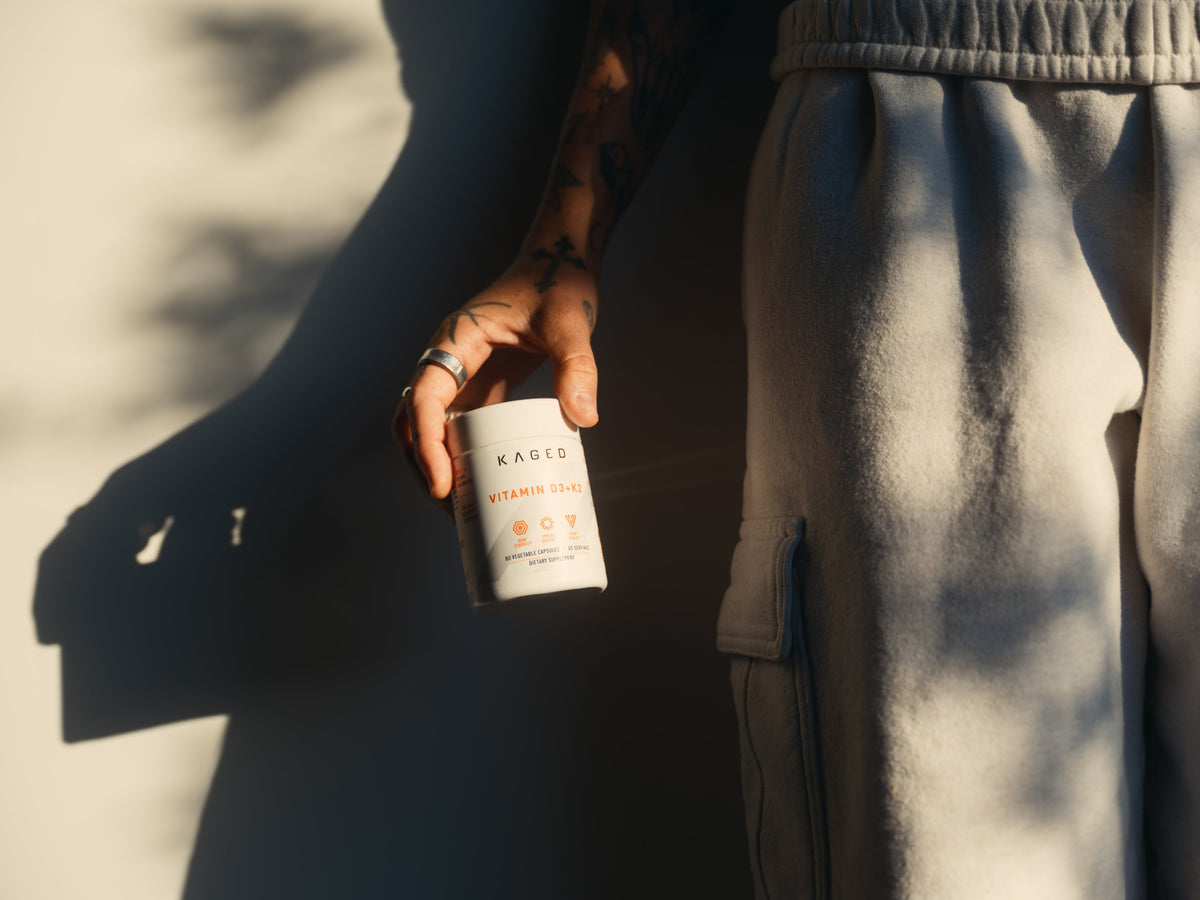
3. Consider a daily supplement. Vitamin D supports calcium absorption, bone health, and immune function. Kaged Vitamin D3 + K2 pairs 5,000 IU of vegan vitamin D3 with 100mcg of MenaQ7® vitamin K2, which activates the proteins that direct calcium into bone tissue. It is one capsule a day, taken with a meal that contains fat.*
See the full breakdown of the formula here.

Common Questions
Do indoor athletes have lower vitamin D than outdoor athletes?
On average, yes, by a small margin. A 2023 analysis of 33 studies and 5,150 athletes found outdoor athletes averaged 31.4 ng/mL and indoor athletes 27.7 ng/mL. Season and latitude had a larger effect than training location.
Can you make vitamin D through a gym window?
No. Your skin needs UVB light to make vitamin D, and glass blocks it. Sunlight through a window does not count.
Which athletes are most likely to run low?
Those who train indoors, train early or late in the day, live at northern latitudes, or are tested in winter and spring. Studies have found high rates in dancers, gymnasts, and basketball players in particular.
Does training outside in winter give you enough vitamin D?
Often not. North of roughly 37 degrees latitude, the winter sun is too low to produce meaningful vitamin D. Premier League soccer players in England saw their average level fall by half between August and December.
Does vitamin D improve athletic performance?
The evidence is limited and mixed. A 2013 review concluded that the trial results were not convincing enough to call vitamin D a direct performance enhancer. The case for keeping your level adequate rests on its established roles in calcium absorption, bone health, and immune function.*
What vitamin D level should athletes aim for?
There is no single agreed number. Many studies treat anything below 20 ng/mL as deficient and 20 to 32 ng/mL as insufficient, and some sports researchers argue for 40 ng/mL or higher. Your healthcare provider can interpret your result.
Is 5,000 IU of vitamin D too much?
It depends on where you are starting. The National Institutes of Health sets the tolerable upper intake level for adults at 4,000 IU per day, and our capsule sits above that. Do not combine it with another vitamin D product. Talk to your healthcare provider first if you take warfarin or another blood thinner, because the vitamin K2 in the formula can interfere with those medications. Read the full explanation here.
References
-
Ogan D, Pritchett K. Vitamin D and the Athlete: Risks, Recommendations, and Benefits. Nutrients. 2013;5(6):1856-1868.
-
Bârsan M, Chelaru VF, Râjnoveanu AG, et al. Difference in Levels of Vitamin D between Indoor and Outdoor Athletes: A Systematic Review and Meta-Analysis. Int J Mol Sci. 2023;24(8):7584.
-
Farrokhyar F, Tabasinejad R, Dao D, et al. Prevalence of Vitamin D Inadequacy in Athletes: A Systematic Review and Meta-Analysis. Sports Med. 2015;45(3):365-378.
-
Harju T, Gray B, Mavroedi A, et al. Prevalence and Novel Risk Factors for Vitamin D Insufficiency in Elite Athletes. Eur J Nutr. 2022;61(8):3857-3871.
-
Aydın CG, Dinçel YM, Arıkan Y, et al. The Effects of Indoor and Outdoor Sports Participation and Seasonal Changes on Vitamin D Levels in Athletes. SAGE Open Med. 2019;7.
-
Constantini NW, Arieli R, Chodick G, Dubnov-Raz G. High Prevalence of Vitamin D Insufficiency in Athletes and Dancers. Clin J Sport Med. 2010;20(5):368-371.
-
Lovell G. Vitamin D Status of Females in an Elite Gymnastics Program. Clin J Sport Med. 2008;18(2):159-161.
-
Halliday TM, Peterson NJ, Thomas JJ, et al. Vitamin D Status Relative to Diet, Lifestyle, Injury, and Illness in College Athletes. Med Sci Sports Exerc. 2011;43(2):335-343.
-
Valtueña J, Dominguez D, Til L, et al. High Prevalence of Vitamin D Insufficiency Among Elite Spanish Athletes. Nutr Hosp. 2014;30(1):124-131.
-
Morton JP, Iqbal Z, Drust B, et al. Seasonal Variation in Vitamin D Status in Professional Soccer Players of the English Premier League. Appl Physiol Nutr Metab. 2012;37(4):798-802.
-
Hamilton B, Grantham J, Racinais S, Chalabi H. Vitamin D Deficiency Is Endemic in Middle Eastern Sportsmen. Public Health Nutr. 2010;13(10):1528-1534.
-
Storlie DM, Pritchett K, Pritchett R, Cashman L. 12-Week Vitamin D Supplementation Trial Does Not Significantly Influence Seasonal 25(OH)D Status in Male Collegiate Athletes. Int J Health Nutr. 2011;2:8-13.
-
Willis KS, Smith DT, Broughton KS, Larson-Meyer DE. Vitamin D Status and Biomarkers of Inflammation in Runners. Open Access J Sports Med. 2012;3:35-42.